.png)
“We Don’t Need the Reports”: The 5 Words That Explain Why Families Are Losing Faith in Mental Health Services.
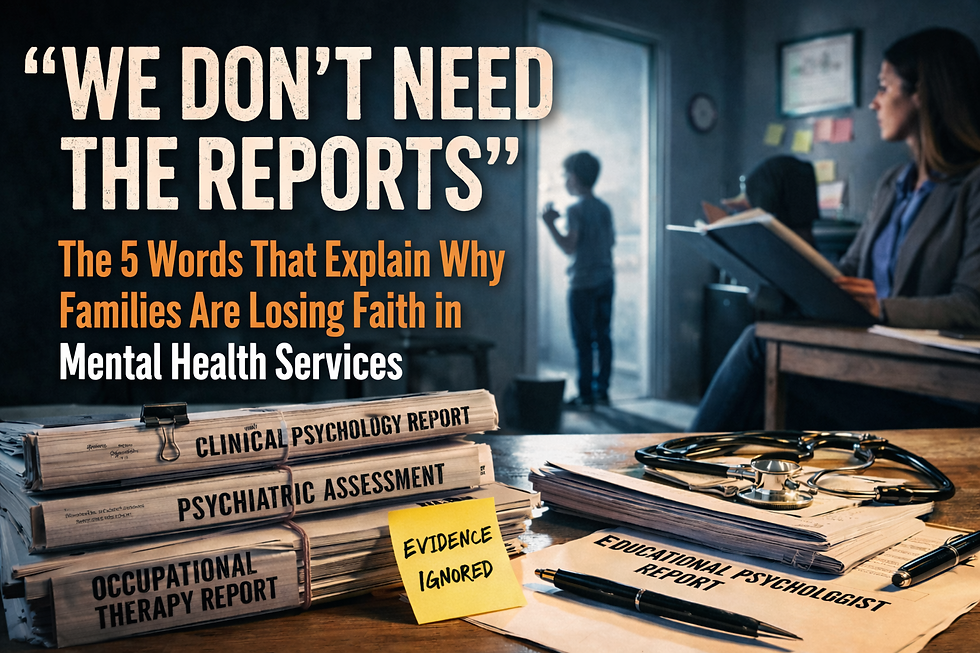
Parents often tell me the system feels impossible to navigate. This week I experienced a meeting that helps explain why. The meeting was with a mental health service provider. The purpose was straightforward: discuss support for a child with significant needs. I came prepared with evidence. A lot of evidence.
The child’s case included:
Two Clinical Psychology reports
A psychiatrist report
Two Occupational Therapy reports
Two Speech and Language Therapy reports
An Educational Psychologist report
A full diagnostic assessment
This is the kind of professional evidence families are constantly told they need. So naturally, I assumed the service would want to review it. Instead, something strange happened. Every time I raised a point there was a pause. Not a reflective pause. A pause that suggested the person was checking what they were allowed to say next. The responses felt structured and cautious, as though the conversation was following a predetermined pathway.
Eventually I asked a simple question:
“Would you like copies of the reports so your clinical team can review the evidence?”
The answer was that the service did not need the reports at that stage, although the GP might find them useful. Let that sink in. Seven professional reports outlining a child’s needs. And the service responsible for assessing support didn’t want to see them.
The Hidden Problem in the System
This experience highlights something many families eventually realise. The person you speak to is often not the person who makes decisions. Many frontline conversations sit within triage systems and administrative pathways designed to manage demand. People are frequently working from scripts, protocols or thresholds. This means that even when families bring substantial evidence, the conversation may still follow a predetermined route.
For parents, this creates a devastating disconnect. They are told to gather evidence. They spend years attending assessments. They pay privately for reports when NHS waiting lists stretch into years.
Then they discover the system they are approaching is not always structured to consider that evidence at the point they present it.
Why Parents Feel Like They Are Not Being Heard
Families often leave these meetings feeling dismissed, confused, or even questioning themselves.
But the issue is rarely about the strength of the evidence. More often, it is about how the system processes information and who has authority to act on it. Understanding this is important, because it changes how families approach the process.
What Parents Can Do
When navigating services like CAMHS or community mental health pathways, a few practical steps can help:
STEP 1. Always follow meetings up in writing. Email summaries create a clear record of what was said.
STEP 2. Submit professional reports formally. Ask for written confirmation they have been logged on the child’s record.
STEP 3. Ask who reviews the evidence. Is it a clinician? A panel? A triage team?
STEP 4. Understand escalation routes. Complaints processes, second opinions and referral pathways exist for a reason.
STEP 5. Don’t assume the person you are speaking to has decision-making authority.
The Bigger Question
The real issue is not individual staff members. Most professionals working within these services are trying to support children while managing overwhelming demand and strict service pathways. The bigger question is this:
How can families have confidence in a system that asks for evidence, yet sometimes appears unable to engage with it?
Until that gap is addressed, frustration, and loss of trust, will continue to grow.
This experience reflects one interaction within a much wider system, and many professionals working within child mental health services provide invaluable support to families every day.


Comments